Educational documents. Required to study abroad or to have a foreign diploma recognised in Türkiye: diplomas, transcripts, equivalence certificates and student certificates.
SWORN TRANSLATION
Sworn Translation and Sworn Translator Services
Sworn translation accepted by official institutions, handled from our Kadıköy office in Istanbul. Stamped and signed, with most documents delivered in 24 to 48 hours.
- 120+ languages
- 24-48 hour delivery
- 20+ years of experience
- 10,000+ completed projects
What Is a Sworn Translation?
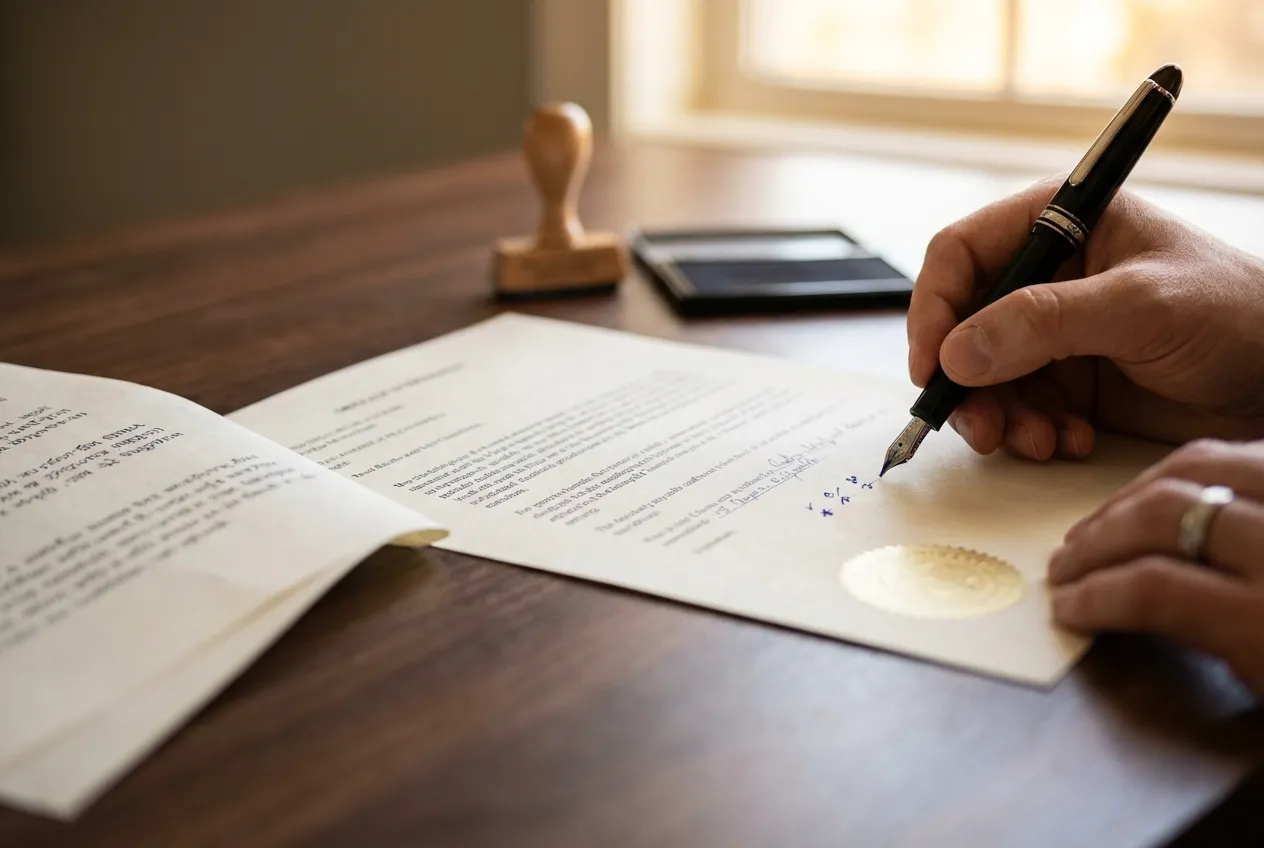
A sworn translation is a translation produced by a translator who has taken an oath before a notary and is therefore authorised to certify it. The translator undertakes, with their own stamp and signature, that the translation is an exact match to the original document.
What separates it from an ordinary translation is authority, not quality. A translation can be flawless in terminology and tone, yet it carries no official weight unless an authorised translator has signed it. A registry office, a university, a consulate or a court looks at who signed the translation before it looks at how good it is.

The Three Things That Make a Translation Officially Valid
The translator's authority. The translator must hold an oath record taken before a notary. Fluency alone does not create authority.
Stamp and signature. The sworn translator certifies every page of the translation with a stamp and a wet signature. This is a personal undertaking as to its accuracy.
An exact match to the document. Nothing in the document may be omitted or added, including seals, dates, reference numbers, footnotes and handwritten annotations.
If any one of the three is missing, the document can be returned by the institution you submitted it to. The cost is not only lost time; it also affects your application timeline and, in some cases, your legal process.
Sworn Translation Compared With Notarised Translation
Both are official, but they are not the same thing. Which one you need depends on the institution receiving the document, and the wrong choice means either an unnecessary notary fee or a rejected application.
| Sworn Translation | Notarised Translation | |
|---|---|---|
| Who certifies it | The sworn translator (stamp and signature) | The sworn translator, then the notary |
| What is certified | That the translation matches the original | The identity and the authority of the translator |
| Where it is accepted | Most official bodies: universities, civil registry offices, municipalities | Bodies that require notarisation, courts, land registry and cross-border procedures |
| Extra time | None | As long as the notary appointment takes |
| Extra cost | None | The notary fee |
| Can it be apostilled | No, not on its own | Yes, it is a mandatory precondition for the apostille |
If your document is going to be used abroad, a sworn translation is often not enough on its own. We set out the correct order for notarisation and the apostille step by step on the Notarised Translation and Apostille page.
If you are not sure, do not guess. Tell us what the document is and which institution will receive it, and we will confirm which certification you need at the quote stage.
Which Documents Require a Sworn Translation?
As a rule, any foreign-language document submitted to an official body requires a sworn translation. These are the four groups we handle most often:
Civil status and identity documents. The basis of identity, family and marital status procedures: population registry extracts, birth certificates, marriage certificates, passports and criminal record certificates.
Legal documents. The group that leaves no margin for error, because the translation carries direct legal consequences: powers of attorney, court decisions, contracts and expert reports.
Commercial documents. These represent your company officially abroad: articles of association, trade registry gazettes, activity certificates and signature circulars.
If your document is not on the list, send us a photo over WhatsApp and we will tell you which type of certification it needs.
The Sworn Translation Process
-
Send the document. Send it over WhatsApp, by email or through the quote form. A legible scan or photo is enough to start.
-
Receive a quote. We give a fixed price based on page count, language pair and turnaround. No line items appear halfway through.
-
Approve and pay. Once you approve the quote, your document is assigned to a specialist translator.
-
Translation and quality control. A sworn translator experienced in the subject completes the translation, a second specialist reviews it, then the stamp and signature are applied.
-
Delivery. We deliver digitally or in print. If notarisation or an apostille is needed, the process continues without interruption.
We sign a non-disclosure agreement for sensitive documents. Your documents are never shared with third parties and are handled over secure transfer channels.
Sworn Translation in 120+ Languages
As a sworn translation office in Istanbul we work in more than 120 languages. These are the ones we handle most often:
- English
- German
- Russian
- Arabic
- French
- Persian
- Azerbaijani
- Italian
- Spanish
- Bulgarian
FAQ
Frequently Asked Questions
24 to 48 hours for standard documents. The exact time depends on the length of the document, the language pair and the certification steps requested. Expedited delivery is available for urgent documents.
The price depends on page count, language pair, the field of expertise involved and the turnaround. We share the total before you approve the quote, and no additional charges appear later.
Universities, civil registry offices, municipalities and many consulates accept a sworn translation on its own. Courts, land registry procedures and applications abroad that require an apostille also ask for notarisation.
A legible digital copy is enough to start the translation. Where notarisation is required, the original document is requested physically.
Yes. We can run the entire process remotely. You send your document digitally and receive the translation digitally or by courier. You do not need to visit our Kadıköy office.
No. A sworn translation is certified by an authorised translator with a stamp and signature. A notarised translation is that same translation additionally certified by a notary. Notarisation is mandatory wherever an apostille is required.
A sworn translator is a translator who has taken an oath before a notary, holds an oath record, and is therefore authorised to certify translations with their own stamp and signature. The authority comes from that oath record, not from language skill alone.
Our Kadıköy office is at Hasanpaşa Mah., İrfanbey Sk., No:10/39 Kat:5. You can bring the document in person or send it over WhatsApp or email and handle everything remotely.
A sworn translation is the translator certifying the accuracy of the translation. An apostille is an official certificate issued by a competent authority so that the document is recognised in another country. An apostille requires notarisation first; a sworn translation on its own is not enough.
More than 120. The languages we work in most often are English, German, Russian, Arabic, French, Persian, Azerbaijani, Italian, Spanish and Bulgarian.
Is Your Document Urgent?
Send us a photo and we will come back with a quote within minutes.
Kadıköy Office
Hasanpaşa Mah., İrfanbey Sk., No:10/39 Kat:5, 34722 Kadıköy/İstanbul